
07.12.2025


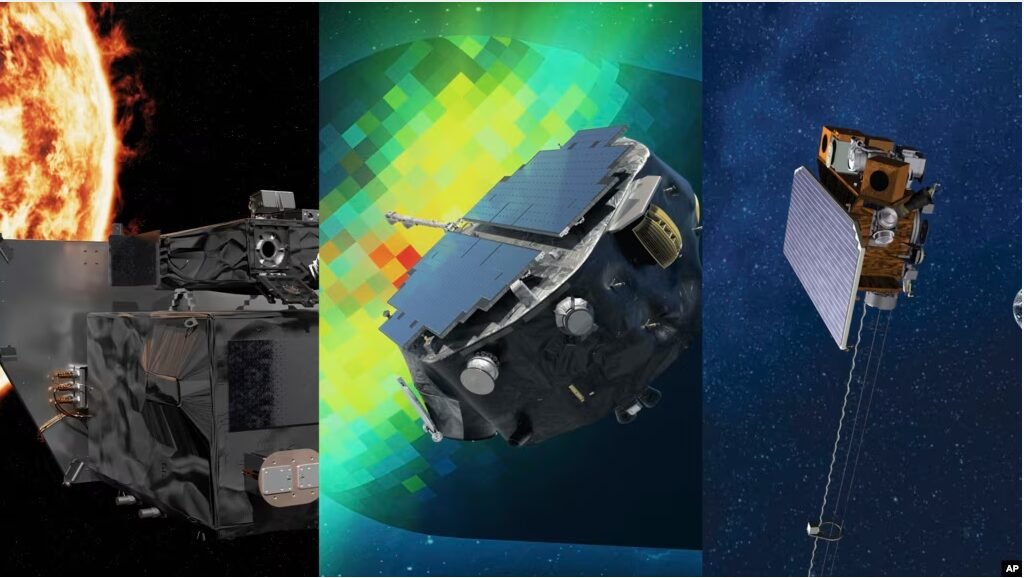

The United States has launched a new mission to better monitor space weather phenomena, such as solar storms that can disrupt technology, aviation, and power systems on Earth. Three spacecraft lifted off from the Kennedy Space Center in Florida aboard a SpaceX Falcon 9 rocket, beginning their journey toward Lagrange Point 1 (L1)—a stable observation point located about 1.5 million kilometers from the Sun.
The Interstellar Mapping and Acceleration Probe (IMAP) will use advanced instruments to examine high-energy solar particles and the protective bubble surrounding our solar system known as the heliosphere. Scientists expect the data to improve understanding of solar radiation and cosmic rays, helping to refine predictions of extreme space weather.
Solar storms, caused by eruptions on the Sun’s surface, release bursts of radiation that are notoriously difficult to predict. Such storms can interfere with satellite communications, mobile networks, aviation systems, and electrical grids, while also posing risks to astronauts in orbit.
Alongside IMAP, the Space Weather Follow-On L1 (SWFO-L1) satellite—operated by the U.S. National Oceanic and Atmospheric Administration (NOAA)—will serve as an early-warning platform. By detecting incoming solar activity in advance, SWFO-L1 is designed to give authorities time to take protective measures.
“This can prevent an incoming threat and give us time to prepare,” explained Irene Parker from NOAA. With timely alerts, astronauts can be sheltered, pilots warned of possible GPS disruptions, and power grid operators prepared for outages.
The third passenger aboard the Falcon 9, the Carruthers Geocorona Observer, will focus on studying Earth’s exosphere—the thin outermost layer of the atmosphere. Its mission is to assess how solar activity interacts with this boundary region and influences conditions closer to Earth.
The mission represents a critical step in safeguarding modern life against the dangers of space weather. As societies become increasingly dependent on satellites, digital communication, and interconnected energy networks, even a single major solar storm could have global consequences.
By combining NASA’s scientific goals with NOAA’s operational monitoring, the mission aims not only to deepen human understanding of the Sun but also to provide practical defenses for Earth against one of nature’s most unpredictable threats.