
Syrians Celebrate Outside UN Headquarters as President al-Sharaa Delivers Historic Speech
Before Syrian President Ahmed al-Sharaa entered the United Nations headquarters in New York to deliver his much-anticipated speech, he paused for a moment to greet the supporters gathered outside. For many Syrians living abroad, the sight of their president at the UN was not just symbolic—it was deeply personal, a moment they described as a victory after years of hardship and struggle.
Voices of Pride and Relief
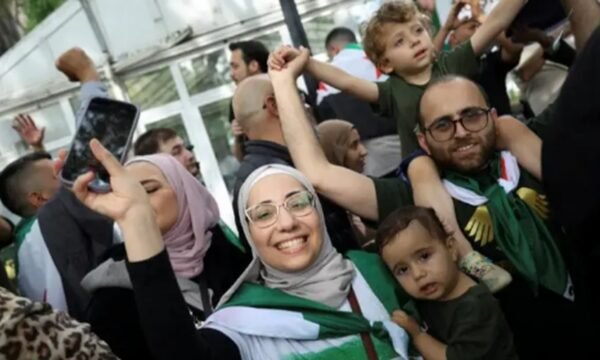
According to international media, the crowd erupted in chants and cheers as they waved Syrian flags, their voices echoing across the streets near the UN building. It was a display of national pride rarely seen in the diaspora community, and it underscored the sense of change many feel under the new Syrian leadership.
Among the supporters was Hoda Kasem, 53, who traveled from West Virginia to witness the event. With tears in her eyes, she described the moment as “justice.” For her, seeing al-Sharaa step into the UN was proof that the voices of Syrians who endured years of war and repression under the Assad regime were finally being heard.
“We went through so much, and this is a victory—it is justice to see him here,” Kasem told reporters. She expressed hope that in his speech, the president would emphasize unity, declaring that Syria belongs to all Syrians, regardless of their background or political past.
The Younger Generation’s Hopes
The scene was not only filled with older Syrians who had lived through the long years of conflict, but also with younger generations who grew up in exile. Zeina Alshahrouh, 19, attended with her sister and father, their faces glowing with excitement.
“I want to see President al-Sharaa continue prioritizing the building of strong relationships with other countries,” Zeina explained. For her and many like her, the hope is that Syria’s future lies in greater international cooperation, not isolation.
Their presence reflected a generational shift: while older Syrians focus on justice and closure, younger ones emphasize opportunity, connection, and rebuilding the nation’s global image.
A Transformed Image on the World Stage
Observers have noted how President al-Sharaa has rapidly transformed his international image. Once a relatively unknown political figure, his ascent to the presidency and his diplomatic style have attracted global attention. His decision to directly engage with Syrian communities abroad—especially in such a symbolic setting as the UN headquarters—signals a deliberate attempt to project inclusivity and reconciliation.
For many Syrians in New York that day, this moment represented not only pride in their homeland but also a shift in narrative. After years of Syria being associated with conflict, destruction, and dictatorship, seeing their president welcomed at the UN was a reminder of hope and possibility.
Unity and Division Among Syrians Abroad
Not all members of the Syrian diaspora share the same enthusiasm. Some remain skeptical of al-Sharaa’s leadership, questioning whether his government can truly deliver the reforms it promises. Yet for those gathered outside the UN, the symbolism outweighed skepticism. They viewed his presence as a validation of their struggles and a potential step toward healing a fractured nation.
Supporters stressed that beyond political differences, what mattered most was reclaiming Syria’s dignity on the international stage. The chants of unity outside the UN reflected a desire to move beyond divisions and focus on rebuilding a shared identity.
Looking Ahead
As President al-Sharaa prepared to deliver his address inside the UN, expectations were high. Supporters hoped he would outline a vision for a Syria that includes all its citizens, commits to reconciliation, and seeks constructive engagement with the international community.
For Syrians like Kasem and Alshahrouh, the day was about more than one speech—it was about recognition. It was about being seen, about believing that after years of loss, their voices and sacrifices mattered.
“This is our moment,” Kasem said firmly. “And it’s only the beginning.”